My latest presentation: 6 Guidelines For Becoming A Social Business.
Showing posts with label twitter. Show all posts
Showing posts with label twitter. Show all posts
Sunday, 1 December 2013
Sunday, 23 September 2012
Business development #fail on Twitter: How NOT to pitch to me.
I believe passionately in the power of professional networking. Specifically, reaching out either in-person (usually at networking events or professional seminars) or via wonderful tools like email, LinkedIn or Twitter to cement a solid business relationship. Almost every day I receive an approach from an advertising/marketing agency, media owner, technology provider (particularly around mobile apps right now) or people looking to work for or with me (job opportunities).
I can’t speak for every brand/client-side marketer but I assume that I’m not alone or particularly unique in receiving these requests. I strongly suspect that marketers’ at most big brands are facing the same issue. Why wouldn’t you want to approach a Marketing Director, Digital leader or key decision-maker at a great brand like adidas, Chanel, Coca-Cola, Johnson & Johnson, Nestlé or (in my case) Samsung?
When done right it opens you, and the company you work for, to wonderful opportunities, better media and marketing and of course, great new partners. The problem is that very often, it is done so poorly or with such little consideration it often comes across as rude or ignorant. That’s why your calls or emails are not returned.
I recently wrote a guest blog post for Firebrand Talent, which goes into detail on how best to approach client-side marketers like me. I've written a commonsense set of 6 guidelines that I hope more people will take to heart. If followed, you're guaranteed to improve your sales success and build better relationships. The article, titled Agencies, media & digital companies: Your sales pitch sucks can be found here: http://blog.firebrandtalent.com/2012/08/agencies-media-digital-companies-your-sales-pitch-sucks/
So with this in mind, I recently had a very strange encounter on Twitter that's left be frustrated and bewildered. I was asked by a supposed expert in social media and digital reputation management in the Philippines Tony Ahn if he could pitch for Samsung work, and get an introduction to the local marketing team. I say supposed, because the Twitter exchange ended in him insulting me personally - isn't that something a digital reputation expert hoping to win new business should try to avoid?
Here's what happened:


If you are not familiar with the terms MAYABANG or YABANG, they roughly translate into arrogant or conceited in English.
Now sure, I might have come across as harsh but I hope the criticism would have been taken in the spirit of improving the communication or finding common ground. After all, my time is limited and I could simply ignore the conversation right? That may be a fair call. But to then take it to a personal level and get to insults, well that's not cool at all. What I find so bewildering about this exchange is how this is coming from an expert in digital reputation management and social media, who is clearly interested in winning new business.
So what do you think? Was I too harsh and deserve the insult? Or is this a case of a senior PR/social media person forgetting where they are (Twitter) and not practicing what they preach? Please let me know in the comments section below.
Update 1: There's a little more fuel that's been thrown onto the fire. This really doesn't seem like the best way to manage a relationship online...


Monday, 23 July 2012
Be a thought leader: Creating, finding and sharing great content
One of the most common questions I’m asked is where do I find all my
content that I publish on Twitter, LinkedIn and other social networks? It’s a
great question that can make or break you as a thought leader. If you’re
consistently posting low quality or poor information this will hurt your
reputation and quickly drive Followers and Connections away. On the other hand,
having a focused stream of excellent content is one of the paths to being a respected
thought leader. I usually publish between 5 and 20 posts per day, every day. So
where do I find all this relevant (and hopefully useful) information?

Here are a few tips and information sources that I find useful when talking about marketing, digital, social media and technology:
The best content is your own.
This might seem like a pretty simple idea but with the
millions of people tweeting, retweeting and reposting other peoples content it’s
often overlooked. The best content, always, is the unique content that you
create yourself. Not everyone has deep industry knowledge and many years of
experience but everyone has a perspective. It’s simple – write down what you
think. This could be anything from a
long, comprehensive article on an aspect of digital like Search Marketing or
Mobile Advertising, or could be a short opinion piece you’ve written in
response to someone else’s content or events/news in the industry. The important
thing is to add your own flavor, in your own voice.
If you’re not sure where to start, there are 3 great blogging platforms I recommend. Google’s www.blogspot.com is what I use for my blog. You might also want to consider www.wordpress.com or www.tumblr.com – they’re all great. They’re also free and easy to set up.
Tips for creating your own unique content.
Not every blog post needs to be the length of a novel, nor does it have to be Shakespeare. It doesn’t have to be written text either – an image, infographic or a video are great for conveying your thoughts and ideas. Here are 5 tips for getting started on your own blog content:
- If you want to be a thought leader in digital, you need to stand for something. There are a lot of different areas of digital including social media, online advertising, creative, web development, video, mobile and search marketing. Pick the ones you’re most comfortable with, or are most experienced in, and simply write. Staying on topic and focus is good. It lets your ideas flow more freely.
- Short is great. A few simple lines or a couple of paragraphs is all you need.
- Longer is better. Sometimes you need to dive deeper into an issue, or feel particularly strongly about a topic. Break your content into sections (similar to this article) and write it down. In-depth articles are more likely to be shared, so when you get some spare time and the passion to write, go do it!
- 4Critique other peoples work. Look at articles on professional publications such as Mashable, Tech in Asia, TechCrunch, Forbes, Marketing Magazine, Ad Age, link to them via your blog and comment on them. Add your own insight or thoughts. Strongly agree or vehemently disagree. It’s your opinion that counts.
- Move beyond the written word. Some of the best and most sharable content is visual. If you have the time and inclination (and don’t feel like writing), get a video camera out and talk through your ideas. Publish it on your blog and make sure you create a YouTube channel. Images and infographics are also fantastic. Either share other people’s images and infographics (but please make sure you acknowledge the owner/source and are not infringing copyright), or better yet create your own.
Twitter (as well China’s
QQ Weibo and Sina Weibo) are the best content aggregators in the world.
Twitter and Weibo are social services that allow you to Follow “interests”. This is fundamentally different from services like Facebook, which encourage you to connect to friends, family and colleagues in more of a social or fun context. The difference is that often you don’t share the same interests as the people you connect with on Facebook. It’s extremely rare that all of your family and friends work in the same job, share the same taste in music or like the same things. But you like them anyway and want to stay in touch. This is your “social network”. Twitter on the other hand is an “interest network” – it encourages you to follow acquaintances, strangers (and sometimes friends) who have the same job, work in the same industry or generally like the same things you do. This means that Twitter is fantastic for finding like-minded people in digital marketing, social media, e-commerce, technology, etc.
The best source of content sharing is Twitter. Follow as many people as possible who you feel are thought leaders or inspire you in what you do. Digital marketing experts have flocked to Twitter and are posting interesting stuff all the time. Take advantage of the unrestricted rules that allow you to follow up to 2,000 other people (note: you can go well beyond 2,000 people but you need to have about the same number, give or take 10%, following you back).
Be a little shameless as you cut and paste other people’s Tweets, or repost content you’ve been directed to. Its good etiquette to list the person you found the content through though, so keep this in mind before blatantly stealing without appropriate recognition. Or you can simply Retweet (RT) other great Tweets you find. Just remember 5 things:
- Focus is good – talk about areas where you want to be a thought leader or seen as an expert.
- Throw in a bit of personal info now and again, but be aware that the vast majority of people don’t want to know what you had for breakfast or intimate details of your last visit to the doctor.
- Interact with others, particularly the experts. Try to thank those that RT your Tweets, or simply comment on great Tweets you come across. Twitter might be focused on building your interest graph but it’s still social.
- Follow and Follow-back is the etiquette, but not the rule. You don’t want your Twitter feed filled with “How to make money online” scams, pointless quotes or irrelevant information. Be nice and follow most people back but carefully read the persons bio and previous Tweets to ensure their content is relevant.
- Be considerate and acknowledge others – it is great when others RT you or share the same content you do. But if you don’t bother occasionally thanking them or acknowledging where the original Tweet came from, people get tired pretty quickly of freeloaders (or even worse plagiarists). It’s just not cool.
Some of the key digital marketing leaders I recommend you
follow on Twitter include: @Econsultancy @eskimon, @hannahlaw, @JamshedWadia, @jeffbullas,
@ladyxtel, @MargeryLyle, @Mashable, @rachelyyhuang, @ruhanirabin and of course
me! @DamienCummings
Professional tech & digital-focused publications I recommend.
Professional tech & digital-focused publications I recommend.
If you’re new to sharing content or just starting out, you’ll quickly realize that there are a few very influential publications that most people are sharing information from. Here are the leading blogs and publications I find useful:
www.mashable.com
www.techcrunch.com
www.socialmediatoday.com
www.forbes.com
www.econsultancy.com
www.techinasia.com
www.businessinsider.com
www.allthingsd.com
Professional marketing publications I recommend.
www.techcrunch.com
www.socialmediatoday.com
www.forbes.com
www.econsultancy.com
www.techinasia.com
www.businessinsider.com
www.allthingsd.com
Professional marketing publications I recommend.
There are many advertising and marketing publications
worldwide. I focus my reading on Asia, specifically Singapore, Southeast Asia, Australia
and China so my list is influenced by this. There are many great publications
around the world, so I encourage you to find others in your country. Here’s my
reading list:
www.adage.com
www.adweek.com
www.adnews.com.au
www.bandt.com.au
www.mumbrella.com.au
www.marketingmag.com.au
www.marketing-interactive.com
www.campaignasia.com
www.campaignsingapore.sg
www.brandrepublic.com
Other excellent reading.
It’s not just the big players that make an impact on me. I regularly read through some of the industry thought leader’s blogs, as well as interesting content from other industries. These include:
www.jeffbullas.com
http://blog.firebrandtalent.com
And of course my own blog “Digital Future”: http://damiencummings.blogspot.sg
Best of luck in your content creation and sharing, I look forward to seeing you on your Blog, Twitter, LinkedIn and other social media!
http://blog.firebrandtalent.com
And of course my own blog “Digital Future”: http://damiencummings.blogspot.sg
Best of luck in your content creation and sharing, I look forward to seeing you on your Blog, Twitter, LinkedIn and other social media!
Thursday, 13 January 2011
Shifting Twitter Trending Topics From 2009 - 2010
Here's a year-to-year trend from 2009 to 2010 in the changes in Twitter trending topics. This data first appear on Ad Age and was compiled by trend tracking company What The Trend.
In Simon Dumenco's Ad Age article, he summed up the changes as: "In essence, Twitterers seem more and more interested in entertaining themselves and each other with hashtag musings than tweeting about commercially-produced entertainment."


In Simon Dumenco's Ad Age article, he summed up the changes as: "In essence, Twitterers seem more and more interested in entertaining themselves and each other with hashtag musings than tweeting about commercially-produced entertainment."


Tuesday, 14 December 2010
eMarketer Research Reveals Marketers Buy In to Promoted Tweets
This is a recent artcile found on eMarketer.
Twitter advertising is attracting more interest from marketers.
In November, the TWTRCON conference and oneforty, an online directory for Twitter tools, surveyed 110 business professionals, mostly from marketing and communications, about their interaction with Twitter’s Promoted Products suite.
Overall, the respondents were interested in using Twitter ads as a part of their marketing mix, with 51% of respondents somewhat or very interested in Promoted Products. However, 27% hadn’t made up their minds and 22% said they had no interest at all.

The survey also noted that many brands and marketers are waiting to see the return on investment and business effect of such programs before getting involved. Buying a Promoted Trend adds the brand or product to the top of Twitter’s Trends list; Promoted Tweets give prominent placement to tweets from the advertiser. A third ad format, Promoted Accounts, includes a branded account among the other accounts Twitter suggests a user should follow.
At the Web 2.0 Summit in San Francisco in November, Twitter co-founder Evan Williams said using Promoted Trends increased the conversation around a topic by three to six times, and that most advertisers return after they have tried the format. Recently, Radio Shack sponsored the Promoted Trend #IfIHadSuperPowers, and Pillsbury used Promoted Tweets to discuss holiday food and recipes.
Twitter users are starting to take notice of the ads. The TWTRCON-oneforty survey found that 37% of respondents have clicked on a Promoted Trend and 29% clicked on a Promoted Tweet.
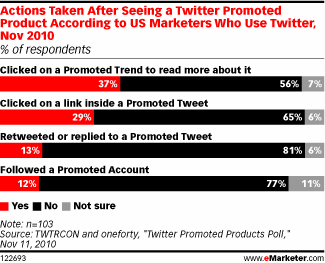
However, Twitter has a lot to do to catch up to other popular ad formats. Only 11% of the TWTRCON-oneforty study respondents said their organizations had used Twitter’s Promoted Products so far, while 59% were using Google AdWords and 55% used Facebook ads.
 In a survey of ad agencies conducted in Q3 2010 by STRATA, 87.9% of respondents said they were likely to use Facebook advertising; less than half as many thought they would use Twitter ads.
Twitter advertising is attracting more interest from marketers.
In November, the TWTRCON conference and oneforty, an online directory for Twitter tools, surveyed 110 business professionals, mostly from marketing and communications, about their interaction with Twitter’s Promoted Products suite.
Overall, the respondents were interested in using Twitter ads as a part of their marketing mix, with 51% of respondents somewhat or very interested in Promoted Products. However, 27% hadn’t made up their minds and 22% said they had no interest at all.
At the Web 2.0 Summit in San Francisco in November, Twitter co-founder Evan Williams said using Promoted Trends increased the conversation around a topic by three to six times, and that most advertisers return after they have tried the format. Recently, Radio Shack sponsored the Promoted Trend #IfIHadSuperPowers, and Pillsbury used Promoted Tweets to discuss holiday food and recipes.
Twitter users are starting to take notice of the ads. The TWTRCON-oneforty survey found that 37% of respondents have clicked on a Promoted Trend and 29% clicked on a Promoted Tweet.
However, Twitter has a lot to do to catch up to other popular ad formats. Only 11% of the TWTRCON-oneforty study respondents said their organizations had used Twitter’s Promoted Products so far, while 59% were using Google AdWords and 55% used Facebook ads.
Monday, 25 October 2010
Social Media Drives Business: 51% Of Customers Reached Via Twitter Are More Likely To Do Business With You
Here's a great infographic from DIYSEO. It states that 51% of people reached via Twitter are much more like to do business with your company/brand. The infographic also nicely demonstrates how social media is being used for demand generation activities for Small & Medium Business (SMBs).


Wednesday, 15 September 2010
Email, Facebook, And Twitter: Retention Or Acquisition?
by Morgan Stewart, Email Insider, 15th September 2010
Email, Facebook, and Twitter each provide marketers with the ability to compile a database full of customers and prospects. This ability to gather consumers into a visible list certainly looks like the familiar paradigm of database marketing. And given the fact these consumers are now part of "our databases," it seems logical that these would meet the criterion for retention marketing. After all, they are in our databases, so the job of acquisition is done, right?
Based on the Subscribers, Fans, and Followers research I have been engaged in over the past several months, looking at the differences in how consumers want to engage with brands through these three channels, I believe this is a potentially serious mistake.
First, consider newly released data on the impact one-to-one communications through these channels have on increased purchase intent.
But think about it. Consumers are generally fans in real life before they "like" companies on Facebook. As such, they already purchase from and endorse your brand frequently. Ever had a friend with a Coca-Cola room in his house? Clocks, barstools, soda fountains -- all Coke. It is possible that level of fan could purchase MORE Coke products? Not likely, but they sure spend a lot of time advocating for the brand. Don't they?
Twitter: Consumers who follow brands on Twitter are actually the most likely to purchase more often after following a brand. The challenge for marketers is that this is still a fairly small segment of the online population. Only 5% of online consumers are daily Twitter users that follow brands on Twitter. Do the math, and you'll see only 3% of online consumers are likely to be influenced to purchase more frequently through Twitter.
So, are these retention-marketing channels?
To some degree, of course they are. However, I believe it is more exciting to think of Facebook and Twitter as acquisition channels.
Facebook is all about connecting with friends and being entertained. Those are the primary reasons people go to Facebook in the first place. Moreover, when people "like" brands, they generally do so to tell others about themselves. If I like Nike, that tells you something about my personality. Some call it social badging, others call it a social resume. Either way, it's about them. It's not an open invitation to receive marketing messages.
Even so, they have liked your brand enough (in real life) to consider this an expression of their personality. They have already advocated for you to their friends. Question is, could they endorse you more? Absolutely. In fact, every time they "like" something you post on your Facebook page, they are endorsing you. Each time they comment on one of your posts, they invite their friends to join in and engage with your brand also. Facebook allow marketers to see word-of-mouth happening. It allows marketers to fuel word-of-mouth. And, to me, word-of-mouth is an acquisition strategy, not a retention strategy.
The same goes for Twitter. It's great that this 3% of consumers may purchase more often, but even greater significance should be placed on the ability of this segment to carry your message beyond Twitter through blogs, private forums, and product reviews. In this same study, we discovered that daily Twitter users are an average of five times more likely to write blogs, and three times more likely to post comments and product reviews than other online consumers. They are VOCAL! The trick is to keep this group happy so that they will generate content that influences others to try your products. Again, it's about acquisition.
Email stands alone as the channel that is squarely in the retention marketing camp. Nine-three percent of U.S. online consumers receive at least one permission-based email message per day, making it by far the most broadly used of these channels for consumers looking to engage brands online. As such, it is likely to drive increased purchase intent among the largest number of online consumers. Combined with the high value consumers place on trust and privacy, and their expectations for relevant and exclusive content, email should serve as the cornerstone for brands' retention marketing strategy.
Expansion of your brand's reach online happens when these channels are integrated into a cohesive strategy. Thinking beyond the database and driving consumers to interact across multiple channels offers marketers the opportunity to leverage these channels for both retention and acquisition.
Email, Facebook, and Twitter each provide marketers with the ability to compile a database full of customers and prospects. This ability to gather consumers into a visible list certainly looks like the familiar paradigm of database marketing. And given the fact these consumers are now part of "our databases," it seems logical that these would meet the criterion for retention marketing. After all, they are in our databases, so the job of acquisition is done, right?
Based on the Subscribers, Fans, and Followers research I have been engaged in over the past several months, looking at the differences in how consumers want to engage with brands through these three channels, I believe this is a potentially serious mistake.
First, consider newly released data on the impact one-to-one communications through these channels have on increased purchase intent.
- After becoming an email subscriber, 27% of consumers say they are more likely to purchase from a brand and another 41% are neutral, which I've interpreted as they may or may not be willing to purchase more. Giving the benefit of the doubt, let's say 68% may be influenced to purchase MORE after becoming a subscriber.
- After becoming a Facebook Fan, 17% are more likely to purchase, with another 34% on the fence. In total, 51% may be influenced to purchase MORE after becoming a Fan on Facebook.
- After following a brand on Twitter, 37% say they are more likely to purchase, with another 31% on the fence. Like email, 68% may be MORE likely to purchase after becoming a follower.
But think about it. Consumers are generally fans in real life before they "like" companies on Facebook. As such, they already purchase from and endorse your brand frequently. Ever had a friend with a Coca-Cola room in his house? Clocks, barstools, soda fountains -- all Coke. It is possible that level of fan could purchase MORE Coke products? Not likely, but they sure spend a lot of time advocating for the brand. Don't they?
Twitter: Consumers who follow brands on Twitter are actually the most likely to purchase more often after following a brand. The challenge for marketers is that this is still a fairly small segment of the online population. Only 5% of online consumers are daily Twitter users that follow brands on Twitter. Do the math, and you'll see only 3% of online consumers are likely to be influenced to purchase more frequently through Twitter.
So, are these retention-marketing channels?
To some degree, of course they are. However, I believe it is more exciting to think of Facebook and Twitter as acquisition channels.
Facebook is all about connecting with friends and being entertained. Those are the primary reasons people go to Facebook in the first place. Moreover, when people "like" brands, they generally do so to tell others about themselves. If I like Nike, that tells you something about my personality. Some call it social badging, others call it a social resume. Either way, it's about them. It's not an open invitation to receive marketing messages.
Even so, they have liked your brand enough (in real life) to consider this an expression of their personality. They have already advocated for you to their friends. Question is, could they endorse you more? Absolutely. In fact, every time they "like" something you post on your Facebook page, they are endorsing you. Each time they comment on one of your posts, they invite their friends to join in and engage with your brand also. Facebook allow marketers to see word-of-mouth happening. It allows marketers to fuel word-of-mouth. And, to me, word-of-mouth is an acquisition strategy, not a retention strategy.
The same goes for Twitter. It's great that this 3% of consumers may purchase more often, but even greater significance should be placed on the ability of this segment to carry your message beyond Twitter through blogs, private forums, and product reviews. In this same study, we discovered that daily Twitter users are an average of five times more likely to write blogs, and three times more likely to post comments and product reviews than other online consumers. They are VOCAL! The trick is to keep this group happy so that they will generate content that influences others to try your products. Again, it's about acquisition.
Email stands alone as the channel that is squarely in the retention marketing camp. Nine-three percent of U.S. online consumers receive at least one permission-based email message per day, making it by far the most broadly used of these channels for consumers looking to engage brands online. As such, it is likely to drive increased purchase intent among the largest number of online consumers. Combined with the high value consumers place on trust and privacy, and their expectations for relevant and exclusive content, email should serve as the cornerstone for brands' retention marketing strategy.
Expansion of your brand's reach online happens when these channels are integrated into a cohesive strategy. Thinking beyond the database and driving consumers to interact across multiple channels offers marketers the opportunity to leverage these channels for both retention and acquisition.
Tuesday, 13 July 2010
Four Key Trends in Australian Social Marketing
The team over at Ogilvy's 360 Digital Influence group recently took a look at the Australian social media landscape. They came up with four very compelling trends:

Australians spend the most time worldwide consuming social media. With almost 7 hours per month spent in social media they "out-social" the US, UK and Italy (one to watch btw). If you factor in the relative population size that puts 17 million users online (80% of the population with 62% via broadband) vs. about 230 million US users or almost 77% of the population).
The social network story is dominated by Facebook. And before we say "duh!" remember that in many Internet-rich countries around the world like Brazil, Japan and Russia, Facebook is not the leader. In Australia, no one stands in Facebook's path towards commanding mass-attention, even the 55+ crowd in Australia is jumping on board.

The biggest gain in year-over-year change in social media usage is interacting with a brand via social networks. That means Facebook and Twitter. Australian consumers are willing to engage with brands via these platforms just as readily as in the United States.

The under 35 crowd wants to access social networks like Facebook and Twitter via their mobile device. With 89% SMS penetration and 20% Web access via mobile (and likely 20% smart phone penetration), all eyes should be on developing the mobile experience for brands.
Australia has its own path towards adoption of social media and it will likely leapfrog other countries including the US in terms of how brands take advantage of their particular usage.
You can read the full Blog posting here.
Friday, 19 March 2010
Social Networking Usage Surges Globally
19th March 2010, Mashable.com
According to the Nielsen Company, the global average time spent per person on social networking sites is now nearly five and half hours per month (February 2010 data), with Facebook accounting for the majority of that time. That’s up more than two hours from last year.
In arriving at that conclusion, Nielsen measured social network usage per person across 10 countries and compared that to data from the same time last year.
When looking at specific countries, Italy tops the charts with social network time per person just under six and a half hours per month (6:27:53), and Australia is a close second (6:02:34). The United States — which has the largest unique social networking audience — ranked third in usage with the average person spending just over six hours (6:02:34) on social networks.
What’s even more interesting is that Facebook— with its 400 million members — is far and away dominating the rest of the competition.
Facebook is the number-one social network destination worldwide and accounts for nearly six hours (5:52:00) per person with the average user logging in more than 19 times per month. What that boils down to is that the time spent on Facebook is almost five hours longer than the time spent on MySpace (0:59:33), the second closest social network in terms of time spent on site per person.
Nielsen also found that:
- Globally, the average Twitterer conducts three unique sessions for a total of 36 minutes per month.
- In the U.S. the active unique social network audience grew roughly 29% from 115 million in February 2009 to 149 million in February 2010.
- Active unique users of social networks are also up nearly 30% globally, rising from 244.2 million to 314.5 million collectively.
The Million Follower Fallacy: Audience Size Doesn't Prove Influence on Twitter
Written by Sarah Perez / March 19, 2010 7:19 AM, http://www.readwriteweb.com
A group of researchers have proven something we already expected to be the case: your Twitter follower count is somewhat of a meaningless metric when it comes to determining influence. To reach this conclusion, the researchers examined the Twitter accounts of over 54 million active users, out of some 80 million accounts crawled by their servers. They then went on to measure various statistics about these accounts, including audience size, retweet influence and mention influence. The conclusion? Those with the largest number of followers may be "popular" Twitterers, but that's not necessarily related to their influence. High follower counts don't always mean someone is being retweeted or mentioned in any meaningful ways.

A group of researchers have proven something we already expected to be the case: your Twitter follower count is somewhat of a meaningless metric when it comes to determining influence. To reach this conclusion, the researchers examined the Twitter accounts of over 54 million active users, out of some 80 million accounts crawled by their servers. They then went on to measure various statistics about these accounts, including audience size, retweet influence and mention influence. The conclusion? Those with the largest number of followers may be "popular" Twitterers, but that's not necessarily related to their influence. High follower counts don't always mean someone is being retweeted or mentioned in any meaningful ways.
The findings from this research project have been published in an research paper available here on the project's homepage.
The study focused on the largest part of the Twitter network - the "single disproportionately large connected component," notes the paper, that contained 94.8% of users and 99% of all links and tweets. Within that large network of "in-use" accounts, the researchers further narrowed down the data to focus on the "active users." These users where those who had more than 10 tweets and had a valid screen name that could be retweeted by others. (Interesting - it's possible to have an account and not a screen name?) That left "only" 6,189,636 active users out of the initial 80 million to examine.
To measure the influence of these 6+ million users, the researchers looked at how the entire set of the 52 million users interacted with these active users.
These three measures of influence - followers, retweets and mentions - has surprisingly little overlap when looking at the top influentials. The top 20 lists from these three categories only had two users in common: Ashton Kutcher and Puff Daddy.
The researchers also examined the ability of Twitter users to influence others. They determined that the most influential users hold significant influence over a variety of topics, as opposed to being experts in just one area.
In the end, what the researchers found was that follower count alone is not necessarily a worthy measure of determining influence. Other factors come into play as well. Although some heavily-followed accounts are also mentioned and retweeted a lot, just looking at audience size doesn't reveal an account's ability to influence and impact the Twitter universe.
According to the project's homepage, the researchers are hoping to make the data they collected available to the community at large. Before doing so, they will discuss it with Twitter in order to determine that their data sharing plan agrees with the company's policy. They plan to have an update on this situation - possibly the data itself - by May 2010.
How the Data Was Analyzed
The data the researchers had access to is astounding: 54,981,152 user accounts, 1,963,263,821 social (follow) links and 1,755,925,520 tweets. In order to collect this massive store of data, the researchers contacted Twitter and asked permission to crawl Twitter's service. Twitter granted them access and white-listed the IP address range for the 58 servers that were used in the data collection. In total, the crawler was able to scan 80 million Twitter accounts during the month of August 2009. Only 54+ million of those accounts were actually in-use at the time, which, in and of itself, is an interesting finding about how many people create a Twitter account and then abandon it. Only 8% of the active accounts were set to private, so they were ignored during the data analysis. The researchers also used the Twitter API to gather additional information about a user's social links and tweets.The study focused on the largest part of the Twitter network - the "single disproportionately large connected component," notes the paper, that contained 94.8% of users and 99% of all links and tweets. Within that large network of "in-use" accounts, the researchers further narrowed down the data to focus on the "active users." These users where those who had more than 10 tweets and had a valid screen name that could be retweeted by others. (Interesting - it's possible to have an account and not a screen name?) That left "only" 6,189,636 active users out of the initial 80 million to examine.
To measure the influence of these 6+ million users, the researchers looked at how the entire set of the 52 million users interacted with these active users.
The Three Measures of Influence
After examining the data, the researchers found that the most followed individuals spanned a wide variety of public figures and news sources and included accounts like CNN, New York Times, Barack Obama, Shaquille O'Neal, Ashton Kutcher, Britney Spears and others. However, the most retweeted users tended to be content aggregation services like TwitterTips, TweetMeme, and, interestingly enough, they counted the tech blog Mashable as an aggregation service, too. Other heavily retweeted users included Guy Kawasaki, the humor site The Onion and again, The New York Times. Meanwhile, those users with the most "mentions" - not a direct retweet including the original content of someone else's tweet, but just a casual mention of their name - were celebs.These three measures of influence - followers, retweets and mentions - has surprisingly little overlap when looking at the top influentials. The top 20 lists from these three categories only had two users in common: Ashton Kutcher and Puff Daddy.
The researchers also examined the ability of Twitter users to influence others. They determined that the most influential users hold significant influence over a variety of topics, as opposed to being experts in just one area.
Examining the 233 "All-Time Influentials"
Out of the 6 million active Twitter users, the researchers picked the top 100 users in each of the three categories. Due to the overlap, there were only 233 distinct users on these lists. These were dubbed the "all-time influentials." Some of these accounts belonged to news organizations or celebs, but others were just regular users. Regarding that last group - it appears that those users who limit their tweets to a single topic are the most likely to increase their influence scores.In the end, what the researchers found was that follower count alone is not necessarily a worthy measure of determining influence. Other factors come into play as well. Although some heavily-followed accounts are also mentioned and retweeted a lot, just looking at audience size doesn't reveal an account's ability to influence and impact the Twitter universe.
According to the project's homepage, the researchers are hoping to make the data they collected available to the community at large. Before doing so, they will discuss it with Twitter in order to determine that their data sharing plan agrees with the company's policy. They plan to have an update on this situation - possibly the data itself - by May 2010.
Friday, 12 March 2010
73% of Twitter Accounts Tweet Less Than 10 times
In fact, a whopping 73% of Twitter accounts have tweeted fewer than 10 times according to a new report from Barracuda Networks, a Web security company.
It seems that Twitter is becoming more of news feed than a social network, said Paul Judge, author of the report and chief research officer at Barracuda. And that raises questions about its growth potential, as well as how the Internet phenomenon will make money.
As of December 2009, only 21% of Twitter account holders were what Barracuda defines as "true users," meaning someone who has at least 10 followers, follows at least 10 people and has tweeted at least 10 times.
That indicates that most Twitter users "came online to follow their favorite celebrities, not to interact with their buddies the way they would on Facebook or MySpace," said Judge.
The follow-only trend exploded when celebrities helped push the microblogging site into the mainstream during a six-month period that Barracuda calls Twitter's "red carpet era."
From November 2008 to April 2009, several celebrities, including Ashton Kutcher, Oprah Winfrey and John Mayer, joined Twitter. And the site grew 21.2% in the month of April 2009 alone.
"The most famous people have already joined Twitter, so I don't think they'll see another growth spurt like that," Judge said.
So the question now, said Judge, is whether Twitter can get more of these followers to start tweeting themselves.
"The bottom line is, most of these people are getting online because Ashton asked them to," Judge said. "If those people do nothing after that, [Twitter's] growth can't hope to continue."
Wednesday, 10 March 2010
Reduce Your Twitter Followers (Without Annoying People)
Jonannejacobs.net, 8th March, 2010
There are countless posts out there telling you how to increase your twitter followers. And there are countless businesses using follower numbers as proof of brand awareness and influence. But there are precious few posts out there telling you how to lose followers that aren’t useful to you. Why would you want to do this? Besides delivering a healthy dose of humility, it just reflects your influence better and it reduces the likelihood of you getting pointless @ replies from bots that just clog up your message stream.
Of course the easiest way to lose followers is to be annoying and to be abusive, inane or too prolific in your posts. But that’s more likely to generate unfollows from real people, and not from bots or zero-tweeters. So this post focuses on ways to lose followers without being annoying.
Getting followers is actually remarkably easy. All you have to do is tweet regularly and offer interesting content. It helps if you can speak at events and/or cover events using twitter and a hashtag, and if you get coverage of your tweetstream in mainstream media. And if you look out for interesting people and talk to them on twitter, you will soon find people will follow you.
But of course, both getting followers and using followers as proof of your popularity are basically pointless. While some of your followers will be legitimate (particularly if you actually do talk to people on twitter), many will be bots, or what’s been described as ‘fauxlowers‘; twitter accounts, particularly of celebrity users, who autofollow you back, even through they have no intention of reading anything you will say on twitter and probably won’t even read your replies to them.
If your objective is to use twitter for productive conversations, or if you want to use twitter to get ideas or research keywords, or if you want to access people who are interested in your products and services, then what you actually need is to follow other people and listen in to their conversations and contribute where appropriate. Ultimately this leads to followers, but you get decent quality followers; people who engage and who probably more accurately represent your sphere of influence anyway.
But in addition to getting better quality followers, there’s the issue with cutting out the rubbish followers from your total. I wanted to share a couple of resources you can use to clean your follower lists. It’s not just about unfollowing people (I use the marvellous ManageTwitter for that) but about getting rid of the bots and lurker or disengaged followers in your list. After all, so long as your account is open, you’re not actually stopping anyone from visiting your twitter user page to read your posts there. You’re just ensuring that people who follow you are actually engaged.
TwerpScan.com is probably the most efficient means of seeing who follows you, and allowing you to see how many followers they have, and when they last tweeted. You can login using your twitter sign in, and then jump straight to ‘Manage your followers’. Then sort your follower lists by last tweet and gasp at the huge number of followers you have that have either never tweeted or tweeted last sometime in 2007 and then abandoned their accounts. Most, you will find, are bots. Yes alright, there may be some among this list that might just enjoy peeking over your shoulder at what you do, but they can do that at twitter.com/your_user_ID. What’s the point of having them among your followers if they don’t tweet and they don’t talk to you? Get rid of them. Block them now!
But what about the followers you have that do tweet regularly but are still bots? TwitBlock is probably the best site to detect whether your followers are spam or bots, and allows you to scan for ’spaminess’ among your followers – marvellous! And if you want to block a spammer just as they start following you, it’s always worth checking an account name with Tweet Blocker to see if they’ve been reported as a spam bot.
Unfortunately, there’s no way to stop someone following you back if you want to follow them (ie: as a news source). So even after you get rid of the spammers and bots and useless twitter followers, your follower list will still be full of people like Guy Kawasaki who actually reads maybe 4 people but ‘follows’ about 54,000 people. I read Guy and I like him, but I have no clue why he follows me because he almost certainly never reads anything I say, even when it’s an @reply directed at him.
So I still can’t help you ensure your follower lists are completely genuine and useful. But perhaps these tools may just give you a more accurate sense of what your influence is more likely to be and a stronger capacity to meet the needs of those who follow you.
Tuesday, 16 June 2009
Monetizing Real-Time Search
Is real-time search marketing the next big opportunity for digital marketing? This article by Scott Morrison looks at how to monetize real-time search and services such as Twitter.
Internet Giants Look For Edge In Real-Time Search
By Scott Morrison of DOW JONES NEWSWIRES. JUNE 15, 2009, 1:54 P.M. ET
SAN FRANCISCO (Dow Jones)--Micro-blogging phenomenon Twitter Inc. hasn't figured out how to make money, but that hasn't stopped Web giants Google Inc. (GOOG), Yahoo Inc. (YHOO) and Microsoft Corp. (MSFT) from racing to establish real-time search capabilities.
Real-time search helps Internet users find Web posts, including those from San Francisco's Twitter Inc., seconds after publication. The field has grown in importance amid the exploding popularity of services like Twitter, which lets users blast short messages rapid fire from computers and mobile phones.
The growth of Twitter has fueled expectations that real-time search could drive Internet advertising to new heights by allowing marketers to target relevant ads at consumers interested in breaking events, hot topics or their favorite celebrities. Some proponents argue real-time data and search could develop into a billion-dollar market.
"Every conceivable advertiser will be interested," said Ron Conway of SV Angel LLC, an early investor in Google and Twitter. "It will create a huge monetization opportunity."
Just how that opportunity will unfold remains unclear. There is no shortage of real-time search startups - such as OneRiot LLC and Scoopler Inc., not to mention Twitter itself - that are attempting to make sense of the growing universe of real-time user-generated data. It is telling, however, that even Twitter still hasn't said how it hopes to turn user updates, known as "tweets," into revenue.
Still, Google, Yahoo and Microsoft are pouring time and resources into the real-time Web. All three have had discussions with Twitter seeking some sort of search or advertising deal, according to people familiar with the situation. They also are looking beyond the micro-blogging leader.
The search giants note other sources of user-generated real-time data, such as Web recommendation engine Digg Inc. or micro-blogging services like Tumblr Inc. They also point to their own properties. Microsoft, for example, notes its Messenger and Spaces services are real-time data sources, while Yahoo highlights its Answers service and its experimental Brazilian micro-blogging property Meme. In January, Google pulled back from its Jaiku service, but recent blog rumors suggest it is poised to launch a service that indexes and ranks content from microblogging services, like Twitter.
Making sense of real-time data poses technological challenges for the big search companies. Their current algorithms return results heavily weighed towards older Web pages that have established credibility and attracted large audiences, an approach at odds with real-time search.
Twitter is like a fire hose spewing out a flood of tweets, many of which are seconds old and from obscure users with little track record. Tweets many times contain acronyms, Web site address abbreviations and emoticons, all of which make it difficult for traditional search engines to evaluate their relevance - and filter out "tweet spam."
"Whoever figures out how to filter out spam best will win the real-time search battle," said Kevin Lee, chief executive of search engine marketer Didit.com LLC.
Prabhakar Raghavan, who runs Yahoo's search strategy, says the company is looking at how it might data mine tweets and other real-time feeds, a process that will help it evaluate and summarize content more efficiently. Yahoo is also looking at whether it might map tweets, allowing advertisers to target geographies where interest in a product or service is growing.
Microsoft senior program manager Andy Oakley says his company is also determining how to filter, summarize and present real-time tweets. He suggests up-to-the minute micro-posts and links could be displayed in an "updates" section within a traditional search results page.
Google last month introduced a "recent results" option to its search engine, and co-founder Larry Page has spoken publicly about the need to continually quicken the pace at which the company's spiders index Web pages. A company spokesman said Google was looking at ways to make real-time data more useful to its users.
Tobias Peggs, general manager at OneRiot, says real-time searchers tend to search the Web many times a day because they expect results will be updated more quickly than on established engines like Google or Yahoo. He believes that gives companies like OneRiot more opportunities to serve up relevant ads based on the changing situations.
"If the latest update on Britney Spears says she wore green Gucci dress last night, that would be an opportunity for Gucci to advertise that green dress," Peggs said.
Subscribe to:
Posts (Atom)