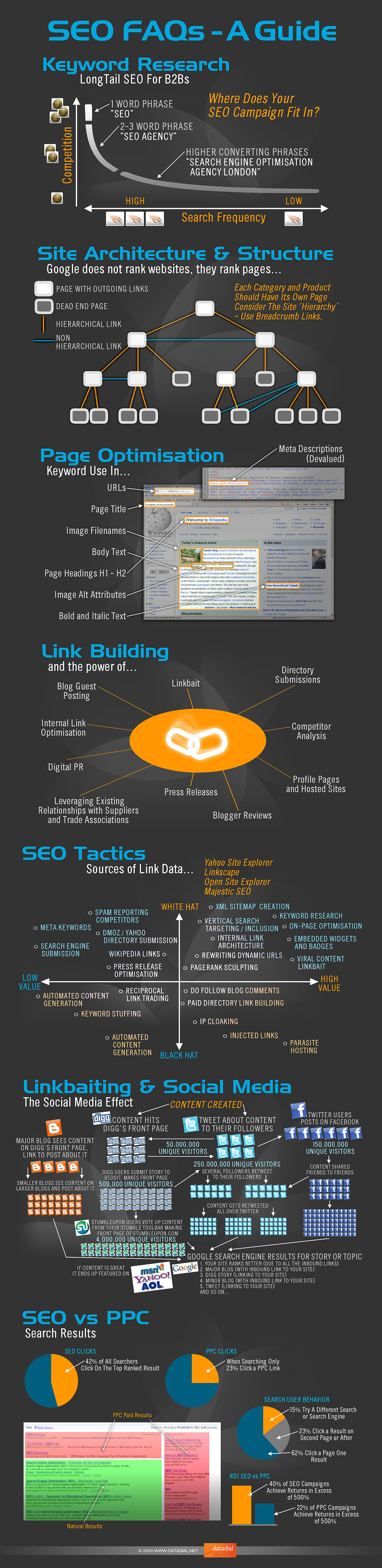
Infographic by PPC Blog
Digital Future explores marketing transformation. Specifically, the move from traditional to digital marketing - covering topics like digital marketing, mobile, social media, search marketing, e-commerce, digital advertising and online strategy.
Search: Digital Future
Showing posts with label Search. Show all posts
Thursday, 8 July 2010
Monday, 19 April 2010
SEO in Pictures
Search Engine Optimisation (SEO) visualised as an infographic. Very well done by the team at Datadial.
Monday, 12 April 2010
Video: The Next Digital Marketing Frontier
By Manny Rivas, Search Engine Watch, Apr 8, 2010
Video, as a marketing channel, has pushed its way into the hearts and minds of marketing agencies and businesses of most sizes. What's not to like? The numbers to quantify the shift speak for themselves. - YouTube receives more than 100 million unique visitors and streams more than 6 billion videos monthly, according to Nielsen.
- Users viewed 33.2 billion videos during the month of December 2009, according to comScore.
- 86.5 percent of the total U.S. Internet audience viewed online video in December 2009, according to comScore.
The State of Video Marketing at SES New York
Search Engine Strategies New York this year featured a keynote aptly named "Video: The Next Digital Marketing Frontier." The session focused on the latest developments in video marketing. The panel was moderated by Zach Rodgers, managing editor of ClickZ. He led the panelists in a conversation by asking insightful questions, ranging from video discovery and ad networks, to ad formats and the importance of engagement.
Before Rodgers jumped into directing questions, Terrence Kelleman, president/designer, Dynomighty Design, took the podium. His viral video and business success story is the type most marketers and businesses dream about.
The first video Dynomighty uploaded to YouTube was a product demo of his company's magnetic bracelet (one of many in-house product designs). It took off and was featured on the home page of YouTube, garnering 2.7 million views. Marketers take note!
In three months, that single video was responsible for $130,000 in sales. For Kelleman, the ability of video to tell an in-depth story of his product beyond a static picture and a buy button, gives video an unparalleled advantage. On the same note, video allows customers to become engaged (one of the major YouTube ranking factors), lending deeper insight into both brand and product.
Not all video marketing strategies focus on the proclivity of a video to become viral as the key to driving campaign success. It's damn cool when it happens, though.
YouTube's Promoted Videos Ad Platform
Kelleman has used YouTube's ad platform for six months, and it has proven effective. Check out the solid ad placement too.
Baljeet Singh, senior product manager, Google, noted that although the platform is still pretty young, it has demonstrated results for all types of advertisers. If the idea is to ensure your content is in line-of-sight, it's a great channel tactic and it can be cheap as well.
Two Advertising Models
Singh agreed that YouTube has one model for small business owners and one model for large brands. Promoted videos can work for both small companies to large companies (e.g., GM).
Video Advertising
Ian Schafer, CEO, Deep Focus, believes people have tried to lend scale to online video advertising in the last couple of years. However, the same way that YouTube has millions of viewers, it's nearly impossible to reach everyone simultaneously.
The practice of placing ads over, around, or between videos has become a commodity. If your goal is to market in these areas, the opportunities have become available, defined, and standardized.
Schafer thinks video ads shouldn't be measured on a CTR basis. Similar to placing an ad on TV, you "won't necessarily get the same scalable result."
Online video captures the opportunity to provide deeper engagement. Video begets engagement and performance should be evaluated based on this metric as opposed to CTR.
Rachel Scotto, metrics strategy consultant, Sony Pictures, said that, in terms of metrics, "video stream" has been the focus for many, but it's not the most important.
What needs to be looked at:
- Milestones in the video: Starts, dropouts, and completions.
- User engagement metrics and video tracking: Where do viewers fast-forward or rewind?
Scotto said if you're hosting the content, deeper engagement can be tracked through "tools you have control over." Because Kelleman hosts videos on YouTube, he gains deeper metric insights through YouTube's analytics package, Insight. He examines Hot Spots to give him an idea of where viewers are becoming disinterested and uses this information when moving forward and designing new videos.
Video and Social Media: How Users Engage With Videos
Kelleman said Dynomighty has an intern whose role is to monitor and respond to video and channel comments. Schafer added that relevant social media buzz will lubricate distribution of content.
Important Social Media and Video Activity Metrics
Scotto said that volume metrics are the key if you're "shooting primarily for exposure." If you're after engagement, then you need to know how much of the video is being viewed. Video production costs are also important. You don't want costs to outweigh the benefit.
Paid Views vs. Organic Views
An increase in paid views will ultimately boost organic views. It's important to look at sources of views and determine where you're receiving the most lift. For example, with YouTube Promoted Videos, running ads on keywords that you rank well for can increase organic views.
One last tidbit: when running promoted video ads in YouTube, play the video from your channel rather than the watch page. This method can increase views for all of your uploaded videos because your content and brand personality will be in line-of-sight.
Search and Rescue: How to Become Findable and Shareable in Social Media
By Brian Solis
Search isn’t an isolated experience. The act of looking for information is now fused with validation, which means the socialization of search will unite discovery with context and relationships. It all begins with where we purposely search for relevant content and also where we respond to interesting information that crosses our path.
ComScore’s most recent search engine ranking report offers new insight that will make us rethink how we publish content, increase its findability, and facilitate sharing.
In comparing February to January, Google remained on top with 65.4 percent of all core search activity. Yahoo followed with 17 percent and Microsoft ranked third with 11.3 percent.
Things become interesting when we analyze search queries as opposed to core search activity. The landscape broadens beyond traditional search.
Just behind Google, but ahead of Yahoo, YouTube ranks second for search inquiries overall. In 18th and 19th place, Facebook and MySpace also make appearances in the top 20 list respectively. Perhaps most intriguing is that neither Facebook nor MySpace offer true search functionality — but they still account for increasing search activity. Facebook is up 10 percent between January and February.
What does this all mean? As social networks gain in prominence, the amount of relevant information within each ecosystem increases in value and, as such, we deliberately seek content within the networks in which we engage.
It’s the Journey That’s Important, Not the Destination
Destination sites across the board are losing traffic and ultimately favor, simply because destinations are obsolete as intended or designed. The days of the traditional “start page” are coming to an end, only to be replaced with the “attention dashboard” — a dedicated application that aggregates the activity of those we follow in social networks into a series of digestible streams.
TweetDeck, PeopleBrowsr, Seesmic, HootSuite, Brizzly, and Facebook each represent a new generation of attention dashboards as they funnel social feeds into one clickable view. These streams look a lot like slot machines as information flies through dedicated columns, almost blurring the text beyond legibility. But this is where attention is focused and the content that appears within it represents the future of the information life cycle.
So how do we compete for attention if attention itself is learning how to adapt to a new media landscape?
Our job is to ensure that information travels outside of our domains and to the communities of interest in order to create a bridge back to our hub. And, content must adapt based on consumption and sharing patterns with our existing and potential stakeholders.
This is an important point and one that can’t be ignored. Social activity indicates that we are already moving away from the act of proactively traveling to traditional sites as a source of new content.
With the dawn of social media, the activity that brings social graphs and networks to life is quickly changing how we discover, learn and share and it is also forever reshaping the idea of online destinations as they exist today. It all comes down to attention and understanding where it’s focused and how it is tempted, lured, or distracted to click away from it.
The socialization of information is changing everything.
Connect with Attention Where Attention is Focused
Competing for attention is paramount. We lose most of the battles before they’re begun because we’re working against years of behavior that now represent the complete opposite of tomorrow’s consumption and sharing patterns.
Everything begins with identifying where attention is focused, combined with the new laws of attraction.
Gigya reviewed data from Compete from November 2009 and observed that some of the top media properties were already realizing a dominant effect in traffic from social networks. For example, USAToday receives upwards of 35 percent of its referral traffic from social networks and just over 6 percent from Google. People Magazine receives 23 percent of its referrals from social networks and 11 percent from Google. And, CNN earns 11 percent of its referral traffic from social versus 9 percent from Google.
Peer-to-peer activity strongly influences the resulting behavior of impressionable nodes defining social graphs, much in the same way we rely upon trusted referrals from our real life contacts. The more something appears within the attention dashboard, the more likely it is that someone will click through. In addition, the more intriguing it seems, or the stronger the reaction it engenders among peers, also increases its enchantment and thus beguiling spectators to willfully lunge towards a shared experience, most likely triggering a public response that continues the social effect.
Social Architecture and Connecting the Dots
Information is already socializing and changing the behavior for how people search, find, react, and curate. The difference between our present and future is defined by the roads and bridges we build between relevance and prevalence.
As content producers, our responsibility is to connect information and stories to existing and potential stakeholders. It’s also essential to package and optimize our content as social objects in order for them to work for us in our absence, when individuals actively seek content through contextual searches.
Originally posted in Search Engine Watch.
Tuesday, 16 June 2009
Monetizing Real-Time Search
Is real-time search marketing the next big opportunity for digital marketing? This article by Scott Morrison looks at how to monetize real-time search and services such as Twitter.
Internet Giants Look For Edge In Real-Time Search
By Scott Morrison of DOW JONES NEWSWIRES. JUNE 15, 2009, 1:54 P.M. ET
SAN FRANCISCO (Dow Jones)--Micro-blogging phenomenon Twitter Inc. hasn't figured out how to make money, but that hasn't stopped Web giants Google Inc. (GOOG), Yahoo Inc. (YHOO) and Microsoft Corp. (MSFT) from racing to establish real-time search capabilities.
Real-time search helps Internet users find Web posts, including those from San Francisco's Twitter Inc., seconds after publication. The field has grown in importance amid the exploding popularity of services like Twitter, which lets users blast short messages rapid fire from computers and mobile phones.
The growth of Twitter has fueled expectations that real-time search could drive Internet advertising to new heights by allowing marketers to target relevant ads at consumers interested in breaking events, hot topics or their favorite celebrities. Some proponents argue real-time data and search could develop into a billion-dollar market.
"Every conceivable advertiser will be interested," said Ron Conway of SV Angel LLC, an early investor in Google and Twitter. "It will create a huge monetization opportunity."
Just how that opportunity will unfold remains unclear. There is no shortage of real-time search startups - such as OneRiot LLC and Scoopler Inc., not to mention Twitter itself - that are attempting to make sense of the growing universe of real-time user-generated data. It is telling, however, that even Twitter still hasn't said how it hopes to turn user updates, known as "tweets," into revenue.
Still, Google, Yahoo and Microsoft are pouring time and resources into the real-time Web. All three have had discussions with Twitter seeking some sort of search or advertising deal, according to people familiar with the situation. They also are looking beyond the micro-blogging leader.
The search giants note other sources of user-generated real-time data, such as Web recommendation engine Digg Inc. or micro-blogging services like Tumblr Inc. They also point to their own properties. Microsoft, for example, notes its Messenger and Spaces services are real-time data sources, while Yahoo highlights its Answers service and its experimental Brazilian micro-blogging property Meme. In January, Google pulled back from its Jaiku service, but recent blog rumors suggest it is poised to launch a service that indexes and ranks content from microblogging services, like Twitter.
Making sense of real-time data poses technological challenges for the big search companies. Their current algorithms return results heavily weighed towards older Web pages that have established credibility and attracted large audiences, an approach at odds with real-time search.
Twitter is like a fire hose spewing out a flood of tweets, many of which are seconds old and from obscure users with little track record. Tweets many times contain acronyms, Web site address abbreviations and emoticons, all of which make it difficult for traditional search engines to evaluate their relevance - and filter out "tweet spam."
"Whoever figures out how to filter out spam best will win the real-time search battle," said Kevin Lee, chief executive of search engine marketer Didit.com LLC.
Prabhakar Raghavan, who runs Yahoo's search strategy, says the company is looking at how it might data mine tweets and other real-time feeds, a process that will help it evaluate and summarize content more efficiently. Yahoo is also looking at whether it might map tweets, allowing advertisers to target geographies where interest in a product or service is growing.
Microsoft senior program manager Andy Oakley says his company is also determining how to filter, summarize and present real-time tweets. He suggests up-to-the minute micro-posts and links could be displayed in an "updates" section within a traditional search results page.
Google last month introduced a "recent results" option to its search engine, and co-founder Larry Page has spoken publicly about the need to continually quicken the pace at which the company's spiders index Web pages. A company spokesman said Google was looking at ways to make real-time data more useful to its users.
Tobias Peggs, general manager at OneRiot, says real-time searchers tend to search the Web many times a day because they expect results will be updated more quickly than on established engines like Google or Yahoo. He believes that gives companies like OneRiot more opportunities to serve up relevant ads based on the changing situations.
"If the latest update on Britney Spears says she wore green Gucci dress last night, that would be an opportunity for Gucci to advertise that green dress," Peggs said.
Subscribe to:
Posts (Atom)